
About this booklet
This booklet tells you what to do if a complaint is made about you. We have included a glossary to help you understand important terms.
About the Teaching Council
The Teaching Council is the regulator of the teaching profession in Ireland. Our role is to protect the public by promoting and regulating professional standards in teaching. One of the functions of the Teaching Council is to investigate complaints about registered teachers.
1. General Information
Why does the Teaching Council look into complaints about teachers?
As the regulator for the teaching profession, we are legally required to look into complaints about teachers registered with us. The specific law is Part 5 of the Teaching Council Act 2001, as amended. You can view or download the Teaching Council Act 2001, as amended, from www.teachingcouncil.ie
Who can complain?
Any person, including members of the public, employers and other teachers, may make a complaint about a registered teacher. In addition, the Teaching Council can itself make a complaint.
Does a complaint have to be raised with the school before it can be considered by the Teaching Council?
In general, the complainant should bring their complaint to the teacher’s school. After that, they can make their complaint to the Teaching Council.
In most cases, we cannot look into a complaint until the school’s disciplinary
procedures (established under section 24 of the Education Act, 1998) have been exhausted¹ (or come to an end), unless there are good and sufficient reasons to proceed.
It is up to the Investigating Committee to decide whether there are good and sufficient reasons. Good and sufficient reasons may include, for example, where children or vulnerable persons are, or may be, at risk of harm, or where the conduct is of such a nature as would bring the teaching profession into disrepute.
When is my employer obliged to give information to the Teaching Council?
The Teaching Council (Information to be furnished by employer in case of dismissal or resignation of registered teacher) Regulations 2023 (No 230 of 2023) (“the 2023 Regulations”) were commenced on 11 May 2023. The 2023 Regulations introduce a legal obligation on employers to provide particular information to us in circumstances where a registered teacher :
(a) is dismissed by his or her employer, or
(b) resigns and that resignation follows upon –
-
- the making of a complaint in relation to the teacher (other than a complaint made in relation to the teacher under section 42 of the Teaching Council Act 2001 (No. 8 of 2001), or
- the invoking of procedures under section 24 of the Education Act 1998 (No. 51 of 1998), or such other procedures as may be invoked, in respect of the teacher.
The information that must be provided, in writing to the Council, is as follows:
(a) the name and address of the employer;
(b) the name and, where known, address of the registered teacher concerned;
(c) the registration number of the registered teacher as entered in the Register of Teachers;
(d) Where the registered teacher has been dismissed
-
- the reasons for the dismissal,
- all documentation relating to the disciplinary process leading to the dismissal, and
- all complaints made in relation to the teacher (including any complaint made in relation to the teacher under section 42 of the Teaching Council Act 2001) which contributed to, or resulted in, the dismissal, including copies of the following:
- letters of complaint;
- statements from witnesses;
- minutes or notes of meetings held with the teacher concerned;
- statements and responses from the teacher concerned.
(e) The circumstances surrounding the dismissal or resignation to include
-
-
- whether those circumstances are the subject of any investigation (including the status of any such investigation) by any other persons, including An Garda Síochána or Tusla (the Child and Family Agency), and
- whether there are any civil proceedings contemplated or in being in relation to the circumstances surrounding the dismissal or resignation, and
-
(f) where known, the current employment status, and place of employment of the registered teacher.
What types of complaints does the Teaching Council look into?
We can only consider complaints in relation to registered teachers. If registered with us, we can look into complaints about:
- professional misconduct;
- poor professional performance;
- engaging in conduct contrary to the Code of Professional Conduct;
- being medically unfit to teach;
- a conviction for certain offences;
- failing to comply with, or contravening a provision of the Teaching Council Act 2001, the Education Act, 1998, the Education Welfare Act, 2000, the Education and Training Boards Act, 2013, and any regulations, rules or orders made under those Acts;
- failing to comply with an undertaking or to take any action specified in a consent given to a panel of the Disciplinary Committee at a previous inquiry; and
- erroneous registration due to a false or fraudulent declaration or misrepresentation.
In addition, the Teaching Council may make a complaint to the Investigating Committee. This would happen in the following circumstances:
- If there is misconduct or harm to a child.
- If information came to light in a vetting disclosure received by the Teaching Council.
Typically, we look into complaints where the matters complained about took place on or after 25 July 2016. If the alleged matters happened sooner, we can only look into the complaint in certain circumstances.
These circumstances include:
- where a teacher was convicted of a particular type of criminal offence; or
- the conduct complained about constituted a criminal offence at the time that it occurred and is of such a nature as to reasonably give rise to a real concern that a child or vulnerable person may be harmed.
For a complaint to be referred by our Investigating Committee to our Disciplinary Committee, the complaint must be of a serious nature.
Can the Teaching Council look into a complaint about something that happened outside Ireland?
We can look into a complaint about something that happened outside of Ireland. It must relate to:
- professional misconduct
- poor professional performance
- convictions for certain offences
Can the complaint against me relate to conduct outside the course of my teaching profession?
Yes, we can look into complaints relating to conduct outside your teaching profession.
These grounds include:
- Convictions for certain offences; and
- Where the conduct is of such a serious nature as would bring the profession into disrepute.
Can the Teaching Council look into a complaint about something that happened outside of the school, while in the course of my teaching profession?
Yes, a complaint against a registered teacher can:
- be about any school-related professional activity; or
- any activity or role undertaken in their capacity as a registered teacher
Will I be notified of a complaint about me?
Yes, we will tell you if we receive a complaint about you. We will send you:
- a copy of the complaint and any documents received with the complaint;
- and any further information we receive about the complaint during the complaint process.
You will have an opportunity to comment in writing on the complaint, and on all information and documents we receive during the complaint process.
Will my school or employer be told about the complaint?
The Investigating Committee may look for information from your school or employer. This would be part of the consideration and investigation of the complaint. Therefore, it is likely that your employer will become aware of the complaint.
In addition, the Investigating Committee will, as soon as possible, notify your employer if the complaint is of such a nature as to give rise to a concerns that you may harm a child or vulnerable person.
At the conclusion of the consideration of the complaint by the Investigating Committee, a copy of the Investigating Committee’s decision will be provided to your employer.
If the Investigating Committee decides to refer the complaint to the Disciplinary Committee for an inquiry, we will tell your employer the outcome of the inquiry after it has ended.
What should I do when I am told of a complaint about me?
You may wish to seek legal advice or the help of a colleague, union representative or other representative.
We cannot give you advice about the issues raised in the complaint, and will not reimburse you for the cost of any representation. We can explain our complaints process to you or your representative.
Is there anything I should not do when I am told of a complaint about me?
You should not discuss the complaint with the person who made the complaint.
If a student/former student is involved, you should not discuss the complaint with them, nor should you discuss it with their parents/guardians.
Privacy Policy
The Teaching Council processes data in accordance with its Privacy Policy.
It may be necessary for us to pass information about a complaint to other bodies. These include Tusla (Child and Family Agency), An Garda Síochána, and/or the National Vetting Bureau. This is in accordance with our obligations regarding the protection of children and vulnerable persons.
2. The complaint process
Who will look into the complaint?
Complaints go to the Director of the Teaching Council and the relevant staff. The Director will review the complaint.
The Director can refuse the complaint if it:
- is not in writing and signed; and
- not accompanied by relevant documents and information.
The Director can also refuse the complaint if the Director thinks it is:
- frivolous;
- vexatious;
- made in bad faith or an abuse of process.
If the Director refuses the complaint, the person who made the complaint can appeal.
They do so by appealing the Director’s decision to the Investigating Committee.
The Director can refer the complaint to the Investigating Committee. If so, the Committee will look into the complaint.
Are there any reasons why the Investigating Committee would not look into the complaint?
The Investigating Committee (the “Committee”) will not look into the complaint if:
- the teacher (subject of the complaint) is not registered with the Teaching Council;
- the Committee believes the complaint does not relate to the teacher’s fitness to teach;
- the school’s disciplinary procedures (established under section 24 of the Education Act, 1998) have not been exhausted or come to an end. However, the Committee may decide that there are good and sufficient reasons to proceed;
- the matters you are complaining about took place before 25 July 2016. In this case, the Committee may still look into the complaint in certain circumstances. These are set out in the General Information section in part 1 above.
If the Investigating Committee decides not to look into the complaint, the complaint process is at an end. It is not possible for the complainant to appeal the decision of the Investigating Committee.
If the Investigating Committee decides to look into the complaint, what will it do?
a) The Committee may ask you to respond to the complaint in writing.
b) The Committee may ask the person who made the complaint to provide more information. The Committee might ask your employer, school, or any other relevant person/organisation, to send in information.
c) The Committee might seek expert advice or help. This may happen if the complaint suggests that you might not be medically fit to teach. If so, the Committee might ask you to undergo a medical examination.
There may be other investigations that the Investigating Committee will conduct. You will be told about the investigations which the Committee is carrying out. You will be provided with all information and documentation which the Investigating Committee receives as part of its consideration of the complaint. You will also be given an opportunity to comment on all information and/or documentation which the Committee has received. This will happen before the Committee makes a decision in relation to the complaint made about you.
Investigating Committee meetings take place in private. You will not be entitled to attend the meetings. The Committee may need to meet on a number of occasions before it makes a decision about the complaint.
What happens after the Investigating Committee has looked into the complaint?
The Investigating Committee can either:
- refer all or part of the complaint to the Disciplinary Committee for an inquiry; or
- decide that no further action is required.
If the Investigating Committee decides that no further action is required, the complaint process is at an end. It is not possible to appeal the decision of the Investigating Committee.
For a complaint to be referred by the Investigating Committee to the Disciplinary Committee, the complaint must be of a serious nature.
Please see below a chart of the complaint process:
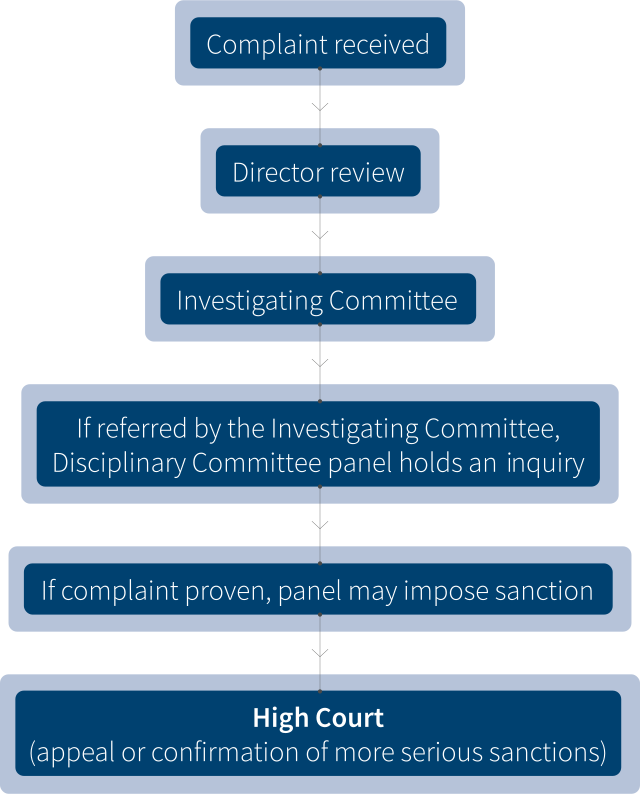
- Complaint received
- Director review
- Investigating Committee
- If referred by the Investigating Committee, Disciplinary Committee panel holds an inquiry High Court (appeal or confirmation of more serious sanctions)
- If complaint proven, panel may impose sanction
- High Court (appeal or confirmation of more serious sanctions)
3. The Inquiry Process
What is an inquiry?
Typically, an inquiry is an oral hearing before a panel of the Disciplinary Committee. It is like a court hearing or tribunal where witnesses give evidence under oath.
However, you can ask for a paper-based inquiry. This means that the inquiry takes place by an examination of documents and written submissions. In addition, the panel of the Disciplinary Committee can ask you to consent this paper-based type of inquiry too. An inquiry by examination of documents and written submissions takes place in private with no one present other than the panel of the Disciplinary Committee conducting the inquiry and its legal advisor.
The panel of the Disciplinary Committee decides on which approach is suitable. In most cases, an oral hearing will take place
Where will the hearing take place?
Most hearings take place at the Teaching Council offices at:
Block A,
Maynooth Business Campus,
Maynooth,
Co Kildare,
W23 Y7X0
Occasionally, hearings may be held elsewhere or online.
Before the hearing, we will write to you with the location, date and time that you should
attend.
How is the hearing prepared?
The Director of the Teaching Council will be responsible for preparing and presenting the evidence to the panel at the hearing. The Director will attempt to prove the complaint at the hearing. The Director will usually get solicitors to prepare and present the evidence at the hearing. Before the hearing takes place, the Director and solicitors will gather evidence such as the following:
- reports
- correspondence; and
- written witness statements.
Before the hearing, we will send you:
- a Notice of Inquiry containing the allegations against you
- copies of all of the evidence; and
- a list of witnesses whom the Director will call to give evidence.
Will the hearing be held in public or private?
Hearings take place in public unless the teacher or a witness requests the panel to hold the hearing or part of the hearing in private, and the panel is satisfied that it would be appropriate to do so. If a hearing is held in public, the panel may, in certain circumstances, keep the identity of the people involved, including the teacher confidential.
Who will be present in the hearing room?
The panel of the Disciplinary Committee – this will include three to five people, who are members of the Disciplinary Committee. One member of the panel will act as Chairperson.
The legal assessor – this is a barrister who will sit with the panel and advise them about legal or procedural issues. The legal assessor does not decide whether the complaint has been proven. This is a matter for the panel only.
The Director’s legal representatives – these may include solicitors or barristers who will present the case on behalf of the Director.
The Teaching Council staff.
You, the registered teacher.
Your representatives – these may include legal, union or other representatives who may act on your behalf. They will put your position to the panel. They will question the witnesses about their evidence. If you do not have representatives, you may do this yourself.
The stenographer – this person records all the evidence given at the hearing.
The public – if it is a public hearing, there may be members of the public, including journalists, present. They usually sit at the back of the hearing room.
Can I question witnesses, or can my representatives do so if I am represented?
The Director’s representatives will call a witness to give evidence. They will first ask the witness questions based on their signed statement.
Then, you or your representatives can ask questions. Afterwards, the panel may ask some questions. This same process applies for all the witnesses called by the Director.
Can I call witnesses or can my representatives do so if I am represented?
Yes, you or your representatives can also call your own witnesses to give evidence. The Director’s representatives and the panel will be able to question your witnesses.
Do I have to give evidence?
No. It is up to you to decide whether to give evidence.
4. After the inquiry
What will the panel do when the inquiry finishes?
Regardless of whether the inquiry takes place as an oral hearing or as an examination of relevant documents and written submissions, the panel will prepare a report at the end of the inquiry. The report will say whether the complaint has been proven. Normally, complaints have to be proven beyond a reasonable doubt.
What could happen to me if the complaint is proven?
If the complaint is proven, the panel will have to decide whether to impose a sanction (penalty).
The panel could decide to:
(a) advise, admonish or censure you;
(b) place conditions on your registration;
(c) suspend you from the register for a set time (up to two years);
(This would mean that you would not be able to teach in a position funded by the Department of Education for the time that you are suspended from the register.)
(d) remove you from the register and not allow you to apply to be restored to the register for a set time.
As an unregistered teacher, you would not be able to teach in a State-funded position. Such positions are funded by the Department of Education and Youth.
You will be invited to make submissions in relation to any proposed sanction.
Can I appeal the decision?
If the panel decides to impose one of the sanctions at b) to d) above, you can appeal the decision to the High Court within 21 days of being notified of the decision. Appeals to the High Court are held in public.
Even if you do not appeal, we must still apply to the High Court for confirmation of the decision, where the sanction is from b) to d) above.
Is my employer notified of the outcome?
Yes, we will notify your employer of the outcome if you are employed as a teacher.
If the complaint is not proven, you can ask the Disciplinary Committee Panel to inform specific people that the complaint has been dismissed or to publish a notice stating that the complaint has been dismissed.
If the complaint is proven, and if a sanction is imposed, we will advise the public of the sanction if we believe that it is in the public interest to do so. We may also decide to publish the findings of the panel if we believe that it is in the public interest to do so.
5. My registration
How is my registration affected by a complaint?
Your registration generally does not change when we receive a complaint about you. It may change if the complaint is proven at an inquiry.
However, please note the following:
(a) If the circumstances warrant, we can ask the High Court to suspend your registration under section 47 of the Teaching Council Act, 2001, for a period of time. This period of time would normally be until we have finished looking into the complaint.
We can make this section 47 application if we consider that it is in the public interest to do so. These applications are rare. They generally only happen where there is a real risk to the public.
You may be informed and invited to attend a meeting before a decision is made to apply to the High Court.
If we apply to the High Court and get a High Court order, we will notify you immediately.
Depending on the terms of the order you may have to:
- stop working completely; or
- stop working in a specific manner or specific role for a period of time.
The High Court shall include in any order, a direction as to whether you shall continue to be paid while the order is in place.
b) lf we receive a complaint about you:
- you will not be permitted to voluntarily withdraw from the Register of Teachers. This can only happen when we have finished considering the complaint; and
- you will not be removed from the Register for failure to apply for renewal of registration. This may only happen when we have finished considering the complaint.
6. Additional information
How long will it take the Teaching Council to consider the complaint?
Each complaint will vary. However, we aim to have a decision made within six to nine months. This timeline is from the date that the complaint is opened. However, this is not always possible, and it can take longer. This can happen where many investigations have been directed by the Committee.
The Investigating Committee may refer the complaint to the Disciplinary Committee for an inquiry. If so, we aim to start the inquiry within twelve months.
There may be other reasons which lead to delays in investigating complaints. For example, a complaint could be the subject of an investigation by An Garda Síochana or Tusla – Child and Family Agency. If so, the Investigating Committee may decide to pause its investigation while this happens. The conclusion of the investigation by An Garda Síochána or Tusla investigation may take time and cause delays.
Also, it can take time to gather all information. This can be outside the Teaching Council’s control. We will keep you updated while the complaint is being considered.
Where can I find out more about the Teaching Council’s complaint process?
If you would like to know more about our complaint and inquiry process, please go to the Fitness to Teach section of our website. You can also contact us by emailing professionalstandards@teachingcouncil.ie
Glossary
You may not be familiar with all the terms in this booklet so we have explained them below.
Advise (as a sanction following an inquiry): to advise the teacher in relation to their future conduct.
Admonish (as a sanction following an inquiry): to reprimand a teacher firmly. Censure (as a sanction following an inquiry): to express severe disapproval of a teacher’s conduct.
Censure (as a sanction following an inquiry): to express severe disapproval of a
teacher’s conduct.
Code of Conduct: the Teaching Council’s Code of Professional Conduct for
Teachers (updated 2nd edition, 2016) is available on Fitness to Teach Section of the Teaching Council website. It contains guidance for teachers. On the date of publication of this booklet, the most recent version of the Code of Conduct is the version that was published in June 2012 and was updated on the commencement of Part 5 of the Teaching Council Act, 2001, as amended.
Complainant: the person who makes a complaint about a registered teacher. This can include members of the public, employers and other teachers. In addition, the Teaching Council can make a complaint about a registered teacher.
Director: the Chief Executive Officer of the Teaching Council.
Disciplinary Committee: the Committee in the Teaching Council from which the Panel who will hold the inquiry is formed.
Employer: the school Board of Management or the Chief Executive Officer of the relevant Education and Training Board which is employing the teacher in question.
Evidence: what a witness says at an inquiry hearing and documents or other
records that are examined during the hearing.
Frivolous: of little importance or trivial.
Inquiry: either a hearing similar to a hearing before a court or tribunal or an
examination of relevant documents and written submissions.
Investigating Committee: the Committee in the Teaching Council that looks into a complaint and decides whether to refer it to the Disciplinary Committee for an inquiry.
Legal Assessor: a barrister who advises the Panel about legal or procedural issues.
Panel: the group of three to five people who will hold the inquiry and decide
whether the case is proven or not.
Poor professional performance: a failure to meet the standards of competence (whether in knowledge, skill, or the application of knowledge and skill or both) that can reasonably be expected of teachers.
Professional misconduct: disgraceful or dishonourable conduct either in the course of the teacher’s profession, or otherwise than in the course of the teacher’s profession, if the conduct is of such a serious nature as would bring the profession of teaching into disrepute.
Sanction: the type of penalty that the Teaching Council can place on a teacher.
Stenographer: the person who records the evidence given at the inquiry.
Vexatious: a complaint made by someone who may not be acting in good
faith, without sufficient cause, and made to cause annoyance to the teacher
complained about.
Vulnerable person: a person other than a child who
- is suffering from a disorder of the mind, whether as a result of mental illness or dementia; or
- has an intellectual disability; or
- is suffering from a physical impairment whether as a result of injury, illness or age; or
- has a physical disability which is of such a nature or degree:
– as to restrict the capacity of the person to guard himself or herself against harm by another person, or
– that results in the person requiring assistance with the activities of daily living including dressing, eating, walking, washing and bathing. - has a physical disability which is of such a nature or degree:
– as to restrict the capacity of the person to guard himself or herself against harm by another person, or
– that results in the person requiring assistance with the activities of daily living including dressing, eating, walking, washing and bathing.